Loading...
Paro
Drukgyel Dzong
MysteryReflectionSolitudeGriefCourage
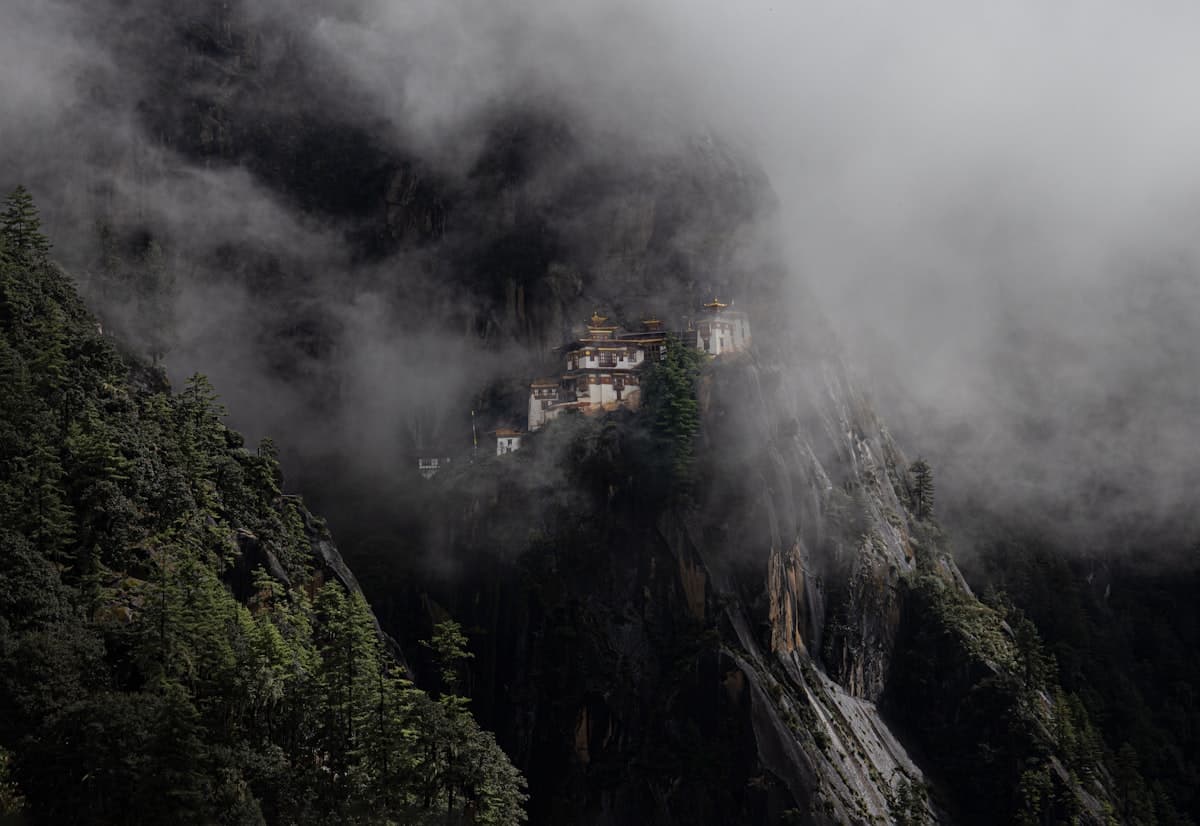
You arrive at the head of the Paro Valley where the road runs out and the mountains take over. The fortress is already broken when you find it. Walls that held for three centuries — crumbling. Roofs that kept monks warm — gone. Windows that framed the Himalayan range — empty, open to wind and rain and the slow work of weather on stone.
Drukgyel Dzong was built in 1649 to celebrate victory over Tibetan invaders. For three hundred years it stood. In 1951, a butter lamp fire destroyed it in a single night. What remains is a ruin that has not been prettified or rebuilt into a museum. It is simply what a fortress looks like when fire and time have had their way with it.
You walk through roofless rooms where grass grows between the flagstones. You stand in doorways that open onto nothing. You find a staircase that climbs to a wall that no longer has a second floor. The mountains are visible through every gap, every wound in the stonework. On clear days, Mount Jomolhari — 7,326 metres, sacred, snow-covered — appears at the head of the valley like a deity deciding whether to reveal itself.
Few people come here. The tour buses go to Tiger's Nest, to Paro Dzong, to the town. Drukgyel sits at the end of the road, quiet, unfinished, patient. The partial restoration work underway adds a strange layer — new stone beside old ruin, fresh mortar against fire-blackened walls. Impermanence and persistence in the same frame. This is not a place for answers. It is a place for sitting with the question of what endures and what does not, and whether the difference matters as much as you thought.
Sensory Profile
Noise Level
Crowd Level
Brightnessbright (open-air ruins, no roof, full exposure to sky and weather)
Temperaturecool to cold (head of the Paro Valley, elevated, exposed to mountain winds)
SmellsCold stone, grass growing in ruins, mountain air, occasionally wood smoke from the small village nearby
Unexpected SoundsWind through empty window frames — a specific, hollow sound. Birds nesting in the walls. Occasional construction sounds from restoration work. The distant sound of a river in the valley below.
Walking Difficultyeasy
Social ExpectationsMinimal. The site is open and unstaffed most of the time. Walk where you wish. There is no guide, no etiquette, no dress code. You are alone with a ruin.
Quiet SpacesYes
Best Time (Low Stimulation)Any time. This place is almost always empty. Early morning for the best chance of seeing Mt Jomolhari (clouds build during the day). Late afternoon for warm light on the stone walls.
Sensory data informed by clinical neurodevelopmental expertise.

Mindfulness Activity
What the Fire Left
Four prompts among the ruins of a fortress that held for three centuries and was destroyed by a butter lamp in a single night.
Grounding and sensory. A way in.
- 1
The Ruins
A fortress that held for three centuries, destroyed by a butter lamp fire in a single night. Walls crumble. Grass grows between flagstones. The sky fills every roofless room.
Standing outside the ruins, looking at the full shape of what remains.
Look at the outline of the fortress against the sky. Find one wall that is still standing and one that has fallen. Notice the colour difference between the old stone and the sky behind it. What shapes do the broken walls make against the clouds?
- 2
The Room
Roofless rooms where grass grows between flagstones. Doorways open onto nothing. Staircases climb to walls that no longer have a second floor.
Standing in the centre of a roofless room, looking up at the open sky.
Stand in the centre of one room. Look up. Where there was once a roof, there is now sky. Feel the wind that enters freely where it was once kept out. Turn slowly. Notice the walls on each side. What colour is the stone? What grows in the cracks?
- 3
The Window
Empty window frames open onto the valley. The same mountains that someone looked at three hundred years ago. The view has not changed. The building has.
Standing in a window frame, looking at the valley through an opening that once held glass or shutters.
Stand where the window is. Place your hands on either side of the frame. Feel the stone. Look through the opening at the valley. Notice what the frame does to the view -- it selects, it composes, it makes the landscape into something specific. Without the frame, it would just be everything. With it, it becomes this.
- 4
The Mountain
On clear days, Mount Jomolhari -- 7,326 metres, sacred, snow-covered -- appears at the head of the valley like a deity deciding whether to reveal itself.
Looking at Jomolhari from the ruins, if visible, or at the clouds where it hides.
If Jomolhari is visible, look at it. Do not photograph it yet. Just look. Notice the snow on the summit, the shape of the ridges, the way it meets the sky. If it is hidden by cloud, look at the cloud. The mountain is still there. You simply cannot see it. Both are worth noticing.
For Curious Minds
Drukgyel Dzong works for the ADHD mind because ruins are inherently interesting — they are unfinished stories, physical mysteries, architecture turned inside-out. There are no ropes, no guided paths, no audio guides. You explore freely. The fortress gives you something to investigate, to climb on, to photograph from unusual angles, and it does all of this in near-total solitude.
- •Ruin Archaeology: Walk through the fortress and reconstruct what it looked like before the fire. Where were the rooms? Where were the prayer halls? Where did the monks sleep? Where would you have stood to defend the valley? The walls tell the story if you read them like a map.
- •Fire Trace: Find evidence of the 1951 fire. Blackened stone, heat-cracked walls, areas where the damage is most severe. Can you determine where the fire started based on the burn patterns? What burned (wood, fabric, butter) and what survived (stone, metal)?
- •Jomolhari Watch: If the mountain is playing hide-and-seek with clouds, set yourself a challenge: wait for a clear view. Find the best vantage point within the ruins. The wait itself becomes an exercise in attention — you are watching a mountain decide whether to show itself.
- •Old and New: The partial restoration means some walls are ancient and some are newly built. Find the boundary lines where old meets new. How do the masons match the old work? Where can you tell the difference? This is a living archaeological process.
- •Photo Essay: Take ten photographs that tell the story of the ruins — before, during, and after. Wide shots, details, textures, sky through windows, grass in cracks. Build a visual narrative of a fortress that fought time and lost gracefully.
Regulation Suggestion
If you feel restless, explore physically — the ruins have multiple levels and areas to walk through. The open-air setting means you can move freely without constraints. If you feel the solitude becoming too heavy, walk down to the small village nearby — there is life there, and the contrast between the quiet ruin and the active village is itself interesting.